
The 10x Shortcut Rule for Percentage Solutions
Relief veterinary surgeons and roving emergency nurses frequently rotate through unfamiliar practices with disparate formularies. When transitioning between emergency shifts, relying on rote memorization across differing vial concentrations invites catastrophic dosing errors. Percentage solutions are defined on a weight-to-volume (w/v) basis: a 1% solution contains 1 gram of solute dissolved in 100 mL of solvent (1 g / 100 mL, which equals 1,000 mg / 100 mL, or 10 mg/mL).
Applying this foundational principle yields the essential clinical shortcut: multiply the percentage concentration by 10 to determine the concentration in mg/mL.
- 2% Lidocaine: 2 x 10 = 20 mg/mL. Essential for rapid arrhythmia stabilization and local regional anesthesia blocks.
- 50% Dextrose: 50 x 10 = 500 mg/mL. Extremely hypertonic stock used for hypoglycemia rescue and fluid bag spiking.
- 0.5% Bupivacaine: 0.5 x 10 = 5 mg/mL. Common in feline and canine dental nerve blocks.
- 8.4% Sodium Bicarbonate: 8.4 x 10 = 84 mg/mL (providing exactly 1 mEq of Na+ and 1 mEq of HCO3- per mL).
When performing high-stakes calculations during unfamiliar rotations, double-checking your calculations against a standardized VTNE Math Prep Guide or using a dedicated Vet Tech Math Resource protects patients from transcription and arithmetic mistakes.
Fluid Bag Spiking: The Universal C1V1 = C2V2 Equation
Creating customized bedside fluid infusions (such as turning a standard balanced crystalloid into a 2.5% or 5.0% dextrose solution) requires the conservation-of-mass formula: C1 x V1 = C2 x V2, where C1 is the stock concentration, V1 is the volume of stock required, C2 is the target concentration, and V2 is the final volume of the fluid container.
To prevent hyperosmolar dilutional drift, always withdraw and discard a volume of crystalloid from the new bag equal to V1 before injecting your additive.
Demystifying mEq/mL for Bedside Electrolyte Supplementation
A milliequivalent (mEq) quantifies chemical bonding capacity rather than raw mass. Standard concentrated potassium chloride (KCl) additive vials contain 2 mEq/mL. When supplementing IV fluids to combat hypokalemia, additions are calculated per liter based on serial serum potassium monitoring.
Locum clinicians navigating varied clinic protocols must establish reliable workflows. Maintaining your own Relief Vet Pharmacy Cabinet Protocols minimizes friction when dealing with unexpected stock volumes and concentrations across different facilities.
Worked Clinical Case: GDV Post-Operative Arrhythmia & Hypoglycemia Support
A 4-year-old male neutered German Shepherd Dog weighing 32.0 kg (70.5 lbs) presents 12 hours post-decompression and gastropexy. The patient exhibits sustained ventricular tachycardia (heart rate: 180 bpm) and a serum potassium of 3.2 mEq/L, alongside borderline hypoglycemia (blood glucose: 62 mg/dL).
Phase 1: Emergency 2% Lidocaine Antiarrhythmic Bolus
Target dose: 2 mg/kg IV slow bolus over 5 minutes. Available vial: Lidocaine 2% (20 mg/mL). Always use standard mL graduated syringes to draw up the volume.
- Calculate Total Milligrams: 32.0 kg x 2.0 mg/kg = 64.0 mg lidocaine required.
- Calculate Liquid Volume: 64.0 mg / 20.0 mg/mL = 3.2 mL of 2% lidocaine IV over 5 minutes.
If conversion to a constant rate infusion is indicated following rhythm conversion, calculate your delivery rate via our validated Canine Lidocaine Arrhythmia CRI Calculator to maintain targeted antiarrhythmic serum levels (25 to 50 mcg/kg/min).
Phase 2: Preparing a 1000 mL Bag of 2.5% Dextrose Crystalloid
Target bag: 1000 mL of balanced electrolyte solution at 2.5% dextrose using 50% dextrose stock (500 mg/mL).
- Apply C1V1 = C2V2: (50%) x (V1) = (2.5%) x (1000 mL).
- Solve for Stock Volume (V1): V1 = (2.5 x 1000) / 50 = 2500 / 50 = 50.0 mL.
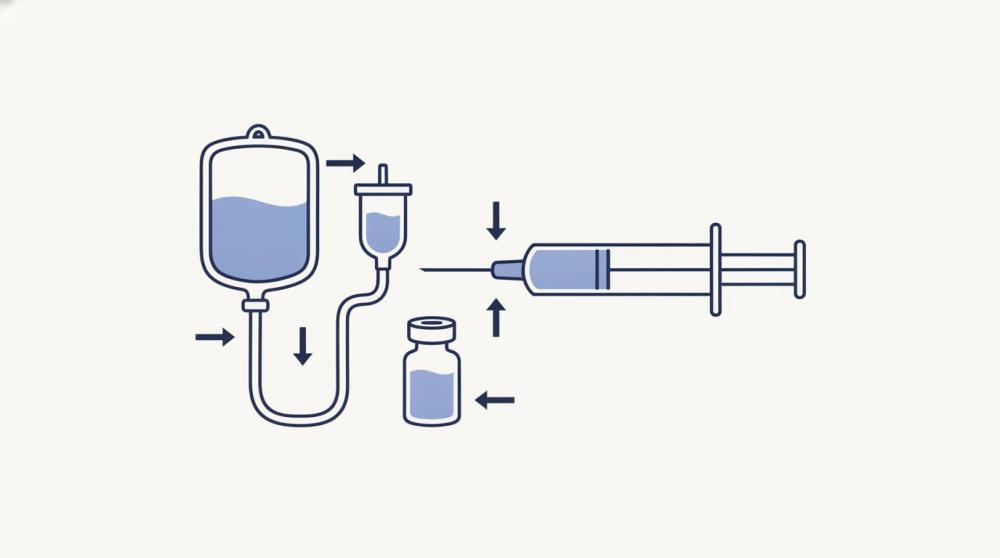
- Execute Bedside Dilution: Withdraw and discard 50.0 mL of crystalloid from the 1000 mL bag, then aseptically inject 50.0 mL of 50% dextrose stock using a standard mL syringe. Mix thoroughly.
Phase 3: Potassium Chloride (KCl) Additive Verification
Target: Supplement 20 mEq/L of KCl. Stock vial: 2 mEq/mL.
- Calculate KCl Volume: 20 mEq / 2 mEq/mL = 10.0 mL of KCl stock added to the 1000 mL bag.
- Verify Potassium Delivery Rate: Fluid maintenance rate is 3 mL/kg/hr = 96.0 mL/hr. Added concentration = 20 mEq / 1000 mL = 0.02 mEq/mL. Hourly K+ dose from supplement = 96.0 mL/hr x 0.02 mEq/mL = 1.92 mEq/hr. Divide by patient mass: 1.92 mEq/hr / 32.0 kg = 0.06 mEq/kg/hr. Even accounting for baseline crystalloid potassium (~4 mEq/L total, delivering ~0.07 mEq/kg/hr), this is safely below the maximum ceiling of 0.5 mEq/kg/hr.
Standardizing Relief Shift Handoffs and Professional Growth
Complex fluid spiking and CRI infusions demand clear communication between day clinicians and incoming night crews. Unambiguous documentation prevents accidental duplicate dosing or omitted additives. Implementing a structured Veterinary Shift Handoff Protocol ensures that active bag concentrations, hourly additive rates, and verification checks remain transparent across shift rotations.
For relief clinicians refining their clinical toolkits, maintaining digital calculation workflows qualifies under professional development allowances. Clinicians can offset clinical reference tools and tracking software by submitting itemized statements through their clinic or sole-proprietor Veterinary CE Allowance Reimbursement budgets.
Clinical References
- Plumb DC. Plumb's Veterinary Drug Handbook, 10th ed., Wiley-Blackwell, 2023.
- American Animal Hospital Association (AAHA). 2024 AAHA Fluid Therapy Guidelines for Dogs and Cats.
- BSAVA Small Animal Formulary, Part A: Canine and Feline, 10th ed., British Small Animal Veterinary Association.
- American Association of Veterinary State Boards (AAVSB). Veterinary Technician National Examination (VTNE) Pharmacology Standards.