Why Cats Are Uniquely Vulnerable to Fluid Overload
Unlike canine patients, cats have a smaller blood volume (~50–60 mL/kg vs. 80–90 mL/kg in dogs) and a high prevalence of subclinical hypertrophic cardiomyopathy (HCM). Administering aggressive canine shock rates or forgetting to step down an infusion pump after rehydration rapidly causes iatrogenic pulmonary edema, pleural effusion, and acute respiratory distress.
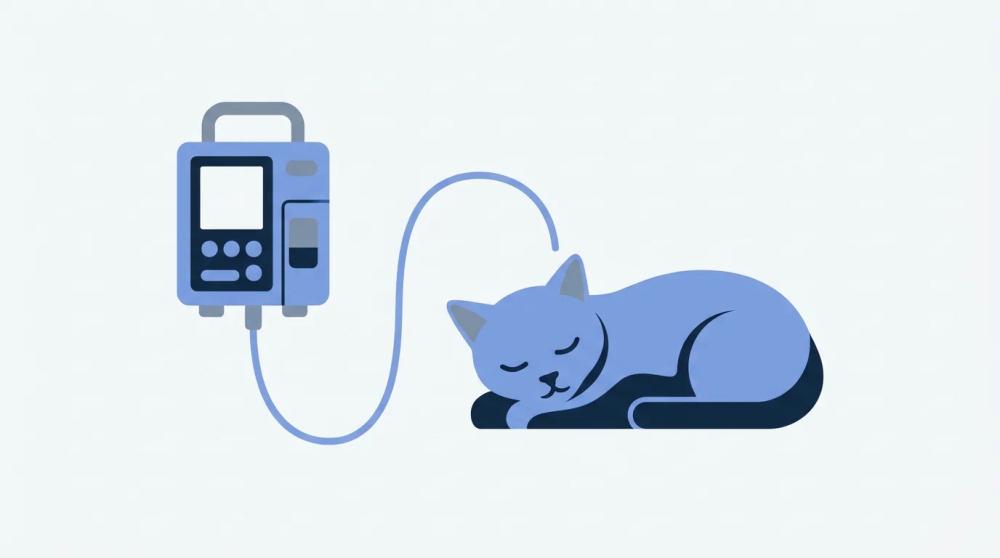
To eliminate 3 AM mental math errors during ICU shifts, clinicians divide resuscitation and rehydration into a structured 2-phase fluid therapy plan paired with an active Veterinary ICU Flowsheet.
The Core 3-Volume Fluid Equation (AAHA & BSAVA Aligned)
Every inpatient fluid plan solves three physiological compartments over 24 hours:
- 1. Dehydration Deficit (mL) = Body Weight (kg) × % Dehydration (as decimal) × 1,000 (Example: 8% = 0.08)
- 2. Maintenance Requirement (mL/day) = 80 × (Body Weight in kg)^0.75 (Advanced ICU RER-based formula) or 40–60 mL/kg/day (conservative feline baseline: ~2 mL/kg/hr)
- 3. Ongoing Losses (mL/day) = Measured or estimated losses from vomiting, diarrhea, polyuria, or third-spacing.
Need to solve these compartments instantly at the cage side? Use our Feline Dehydration Fluid Calculator or the AAHA 3-Volume Fluid Engine.
Worked Clinical Example: 4.2 kg Cat at 8% Dehydration
Patient Signalment: 4.2 kg (9.26 lb) adult Domestic Shorthair cat presenting with tacky mucous membranes, delayed skin tent, and mild azotemia (estimated 8% dehydration; no active hypovolemic shock). Ongoing losses estimated at 40 mL/day from mild emesis.
Step 1: Convert Weight & Calculate Deficit
- Weight in kg: 9.26 lbs ÷ 2.2046 = 4.2 kg
- Deficit Volume: 4.2 kg × 0.08 × 1,000 = 336 mL
Step 2: Calculate Feline Maintenance (24h)
- Using conservative feline metabolic rate (80 × 4.2^0.75 ≈ 234 mL/day, or ~9.8 mL/hr). (Alternatively, standard 45–50 mL/kg/day gives 189–210 mL/day).
Step 3: Build the 2-Phase Infusion Schedule
- Phase 1 (Deficit Replacement + Maintenance + Losses over 12 hours):
To rehydrate gently without overwhelming left atrial pressure, split the 336 mL deficit over 12 hours (28 mL/hr), added to hourly maintenance (9.8 mL/hr) and ongoing losses (1.7 mL/hr):
Phase 1 Pump Rate = 39.5 mL/hr for Hours 0–12. - Phase 2 (Physiological Maintenance Step-Down, Hours 12–24):
Once hydration parameters normalize, drop the pump strictly to Maintenance + Ongoing Losses = 11.5 mL/hr.
For full nursing checklists, review our guide on how to Prevent Fluid Overload in Cats and our Vet Tech Math Cheat Sheet.
When Shock Boluses Are Required First
Dehydration (interstitial/intracellular loss) is distinct from hypovolemic shock (intravascular depletion). If a patient presents with pale mucous membranes, prolonged CRT (>2 sec), hypothermia, or hypotension:
- Feline Shock Bolus: 5–10 mL/kg of isotonic crystalloid (LRS or Hartmann’s) over 15–20 minutes, reassessing lung sounds and blood pressure after every bolus.
- Canine Shock Bolus: Refer to the Canine Shock Fluid Rate Calculator or derive exact hourly pump settings with the IV Bolus Rate Calculator.
- For concurrent diabetic ketoacidosis, transition directly to the Feline DKA Fluid & KCl Protocol.
Bedside Monitoring Parameters Across Global Standards
Whether practicing under AAHA (US), BSAVA/RCVS (UK), CVMA (Canada), FECAVA (EU), or AVA (Australia) standards, monitor every fluid-receiving cat every 4 hours for early overload cues:
- Resting respiratory rate creeping above 30–36 breaths/min
- New soft heart murmur, gallop rhythm, or fine pulmonary crackles
- Chemosis (conjunctival edema) or clear serous nasal discharge
- Acute body weight gain exceeding 5–10% over baseline rehydrated weight